The Past, Present, & Future
Honoring God and His People
This page seeks to honor God's past work and tell stories to encourage and inspire God's work moving forward rather than idolizing the past as Ecclesiastes 7:10 so wisely asserts, "Do not say, “Why were the old days better than these?” For it is not wise to ask such questions.”" While also encouraging God's people not to forget God with the visual reminder 12stones and remembering God to proactively fight against forgetting, avoid pride, and praise the Lord as Deuteronomy 8 talks about "10 When you have eaten and are satisfied, praise the Lord your God for the good land he has given you.11 Be careful that you do not forget the Lord your God, failing to observe his commands, his laws and his decrees that I am giving you this day.12 Otherwise, when you eat and are satisfied, when you build fine houses and settle down,13 and when your herds and flocks grow large and your silver and gold increase and all you have is multiplied,14 then your heart will become proud and you will forget the Lord your God, who brought you out of Egypt, out of the land of slavery.15 He led you through the vast and dreadful wilderness, that thirsty and waterless land, with its venomous snakes and scorpions. He brought you water out of hard rock.16 He gave you manna to eat in the wilderness, something your ancestors had never known, to humble and test you so that in the end it might go well with you.17 You may say to yourself, “My power and the strength of my hands have produced this wealth for me.”18 But remember the Lord your God, for it is he who gives you the ability to produce wealth, and so confirms his covenant, which he swore to your ancestors, as it is today."
A Brief History
Westminster Wesleyan Church traces its roots to the earliest days of Wesleyan Methodist work in South Carolina. In November 1893, under the leadership of Rev. H. S. Abbott, a congregation of approximately twenty-five members was organized in Westminster following a series of revival meetings. This work emerged during the initial expansion of the Wesleyan Methodist movement into the Upstate and represents one of the earliest efforts to establish a holiness-focused church in the region.
These early meetings were marked by both opposition and spiritual response. Accounts from the time describe strong resistance at first, followed by growing openness, with many individuals responding in conversion and renewed commitment to Christian life. Westminster quickly became a recognized point of ministry within the young South Carolina Conference, even hosting large gatherings in its earliest years.
Following this initial organization, the historical record becomes sparse. By 1910, the work in Westminster had been reorganized under the leadership of Rev. John H. Newton, suggesting that the earlier congregation had diminished or ceased regular activity for a period of time. From this point forward, the church developed into a more stable and continuous presence in the community. By 1914, the church had cleared its indebtedness, marking an important step toward long-term sustainability.
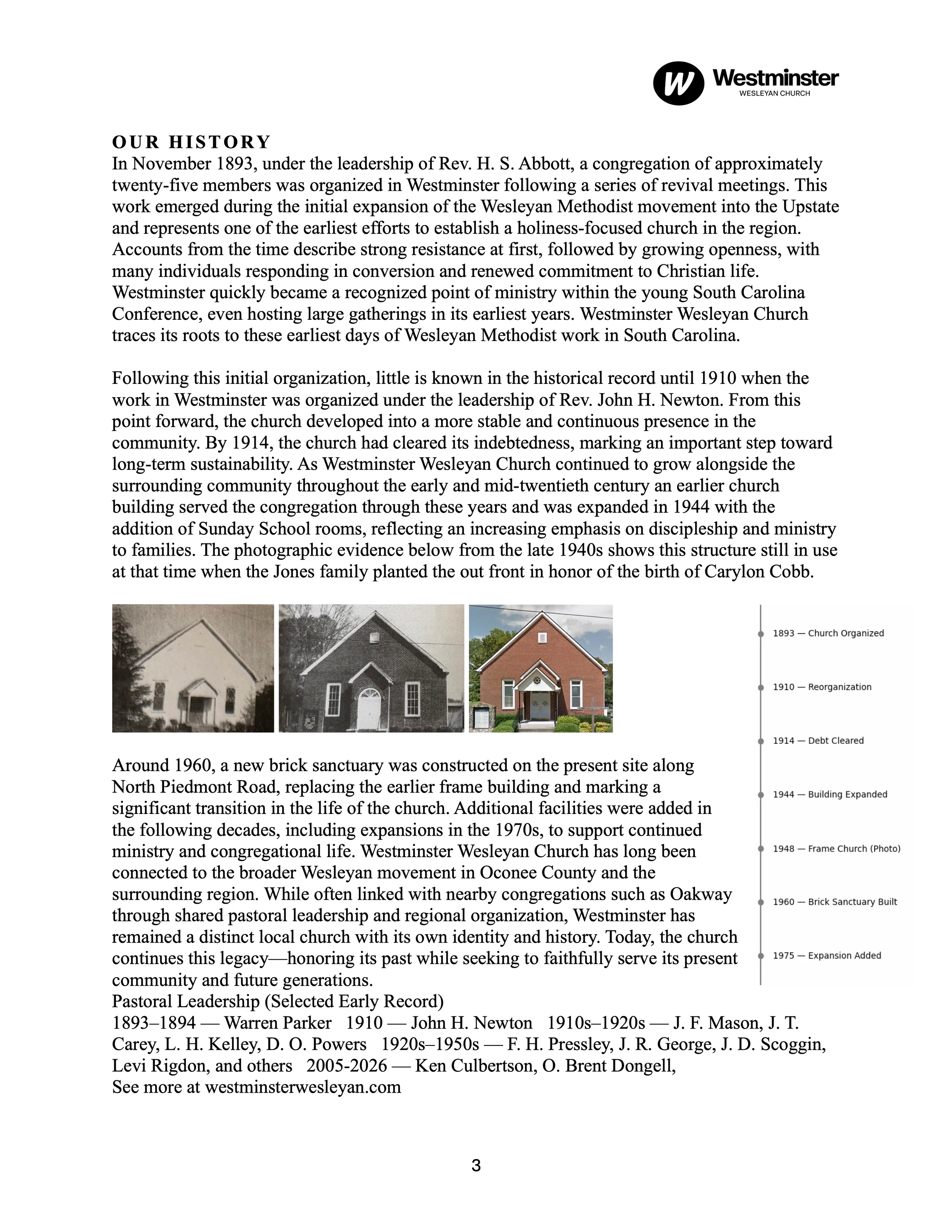
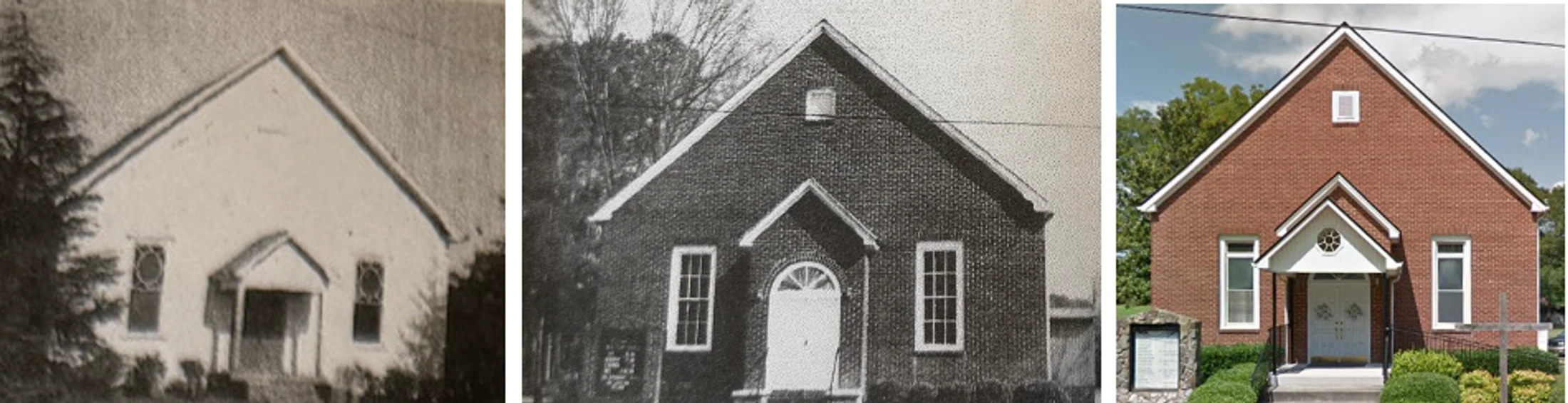
Throughout the early and mid-twentieth century, Westminster Wesleyan Church continued to grow alongside the surrounding community. An earlier church building served the congregation through these years and was expanded in 1944 with the addition of Sunday School rooms, reflecting an increasing emphasis on discipleship and ministry to families. Photographic evidence from the late 1940s shows this structure still in use at that time.
Around 1960, a new brick sanctuary was constructed on the present site along North Piedmont Road, replacing the earlier frame building and marking a significant transition in the life of the church. Additional facilities were added in the following decades, including expansions in the 1970s, to support continued ministry and congregational life.
Westminster Wesleyan Church has long been connected to the broader Wesleyan movement in Oconee County and the surrounding region. While often linked with nearby congregations such as Oakway through shared pastoral leadership and regional organization, Westminster has remained a distinct local church with its own identity and history.
Across generations, the church has been shaped not only by pastors and leaders, but also by families and individuals whose lives have been marked by faith, prayer, and service. From early revival meetings to seasons of growth, rebuilding, and renewal, Westminster Wesleyan Church has remained rooted in a commitment to holiness, community, and the transforming work of God.
Today, the church continues this legacy—honoring its past while seeking to faithfully serve its present community and future generations.
Pastoral Leadership (Selected Early Record)
- 1893–1894 — Warren Parker
- 1910 — John H. Newton
- 1910s–1920s — J. F. Mason, J. T. Carey, L. H. Kelley, D. O. Powers
- 1920s–1950s — F. H. Pressley, J. R. George, J. D. Scoggin, Levi Rigdon, and others
Testimonies
To come are recorded, video, audio, written testimonies of our church expressing God's goodness and work
connected to and among our local church community over the years.
Here is a one page link from the 2026 Annual Conference report below